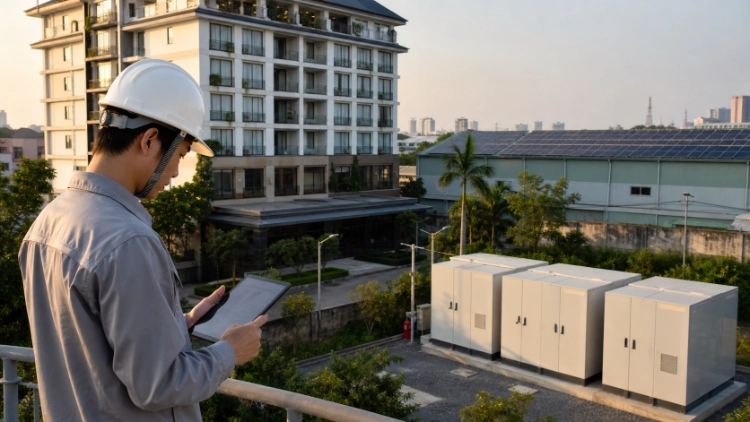

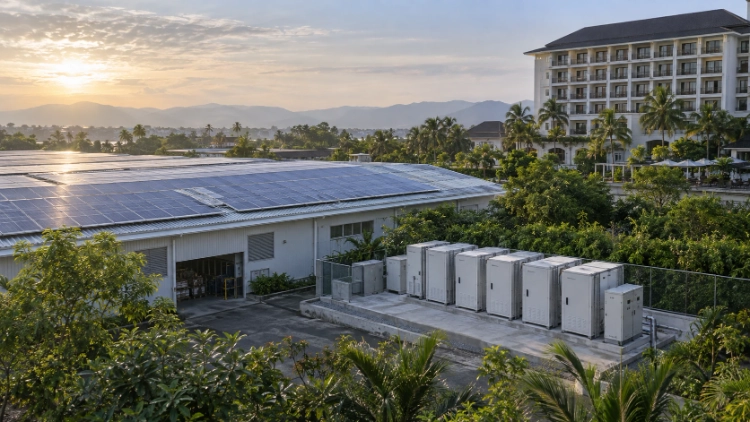
Energy storage can reduce a Vietnamese hotel’s or factory’s peak electricity cost when it is dispatched against a measured load curve, not when a battery is simply added to the site. The decision starts with interval demand data, the tariff definition of a peak period, the usable energy and power rating, and the value of keeping critical loads online. A credible ROI case then compares several operating scenarios instead of promising a fixed payback.
Why peak cost needs a load profile
Hotels often combine air-conditioning, pumps, kitchens, lifts, laundry and guest-room loads. Small factories may have compressors, motors, process equipment and shift changes. A supermarket adds refrigeration that may run continuously. The same battery size can produce very different value in each facility because the timing, duration and coincidence of the peaks are different.
Start with at least several weeks of interval data, then separate the following questions: when does the site reach its highest demand, how long does that demand last, which loads are flexible, and which circuits must remain available during an outage? The word peak should follow the applicable utility or billing rule, not an assumed clock window.
Four value streams to include in an ROI model
1. Peak shaving
A battery can discharge when site demand approaches a target threshold. The avoided cost depends on the tariff structure and on whether the system can reliably deliver the required kW for the full peak interval. A short high-power event and a long lower-power event are different sizing problems.
2. Solar self-consumption and time shifting
When rooftop solar generation does not match the facility’s load, storage can move part of the energy to a later operating period. Model charging limits, conversion losses, state-of-charge reserve and the hours when the facility is actually open. Do not count the same solar kWh twice as both self-consumption and peak shaving.
3. Continuity for critical loads
Hotels may protect reception, communications, pumps or selected guest services. Factories may protect controls, safe shutdown sequences and restart equipment. Supermarkets may prioritize refrigeration and point-of-sale systems. Put this value in a separate scenario because the avoided disruption cost is site-specific and should not be presented as guaranteed savings.
4. Control and operating discipline
An energy management system turns a battery into an operating asset. The controller should respect the facility’s demand target, solar forecast, reserve level, battery limits and outage priority. Manual dispatch can miss a peak or discharge too early, which weakens the business case.
Size power and energy separately
Power is the instantaneous capacity used to cover a peak in kW. Energy is the usable amount available over time in kWh. A site may need high power for a short motor-starting or demand event, or more energy for a long evening load. The sizing sequence is:
- Map the interval load curve and identify the target demand threshold.
- Measure the kW that must be offset and the minutes or hours it lasts.
- Reserve capacity for outage priorities and minimum state of charge.
- Apply conversion efficiency, temperature, degradation, warranty limits and the planned operating horizon.
- Check protection, interconnection and local installation requirements with the project engineer.

What EPOTR configurations show
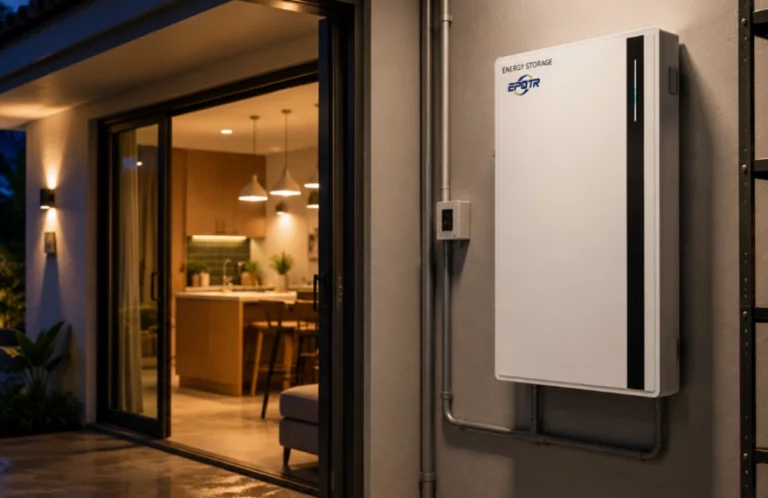
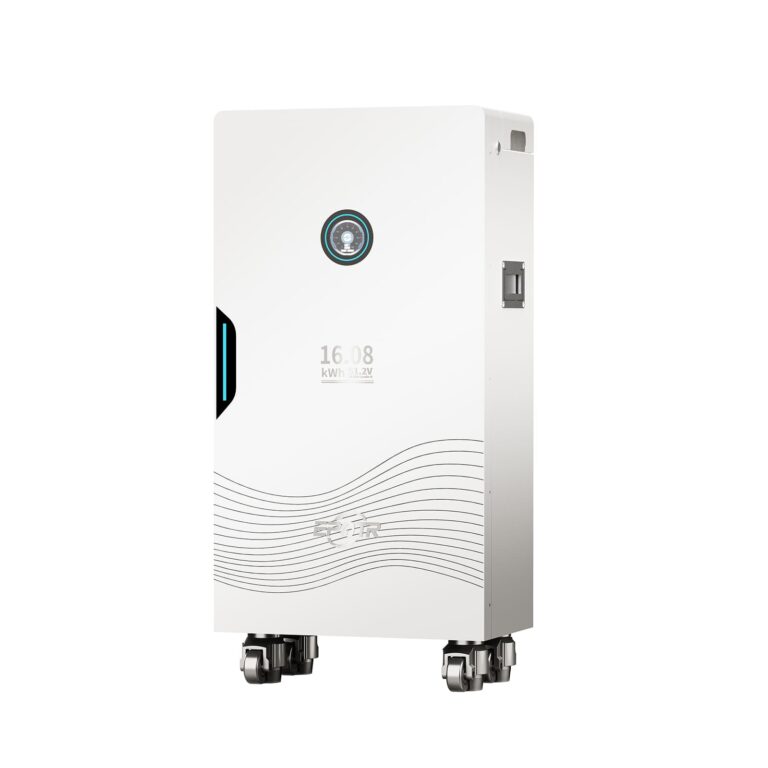
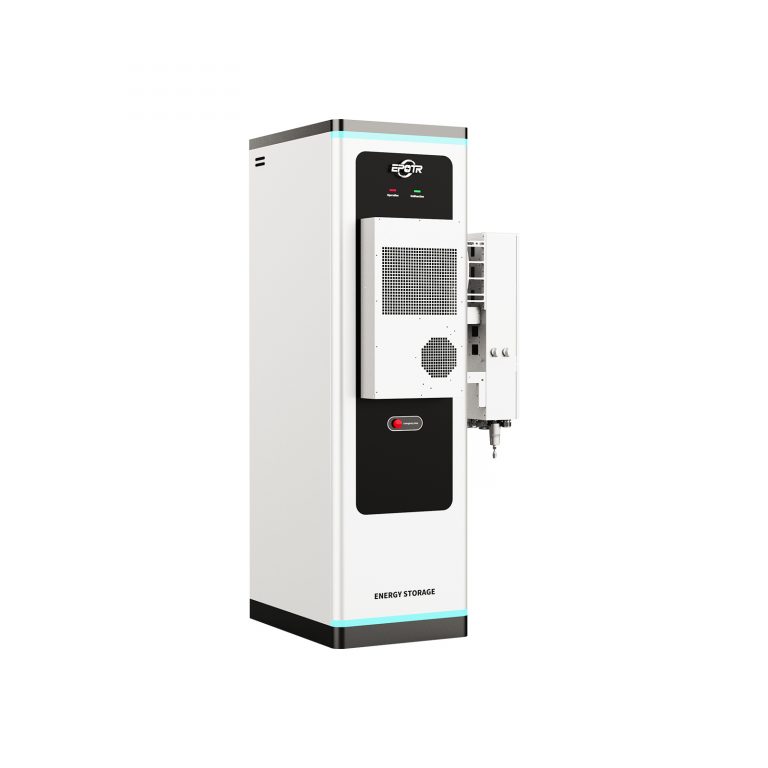
EPOTR commercial and industrial ESS range includes configurations for facilities that need solar integration, storage and controllable power. The EP1 all-in-one hybrid energy storage system is described for supermarkets, farms and small factories and supports self-consumption, time-of-use and backup modes. Its listed EP1-50K-T6 configuration includes 50 kW rated AC power, 57.3–100.3 kWh battery energy, six MPPTs, 200% PV oversizing and up to ten units in parallel. These figures describe a product configuration, not a universal recommendation for every Vietnamese site.
For a larger project, the C&I product section lists the EP-CB2-215KL-100K at 100 kW rated AC power and 215.04 kWh system capacity, using LFP cells and listing IP54 and system efficiency above 88%. Final thermal design, protection settings, interconnection and operating limits must be confirmed for the selected configuration.
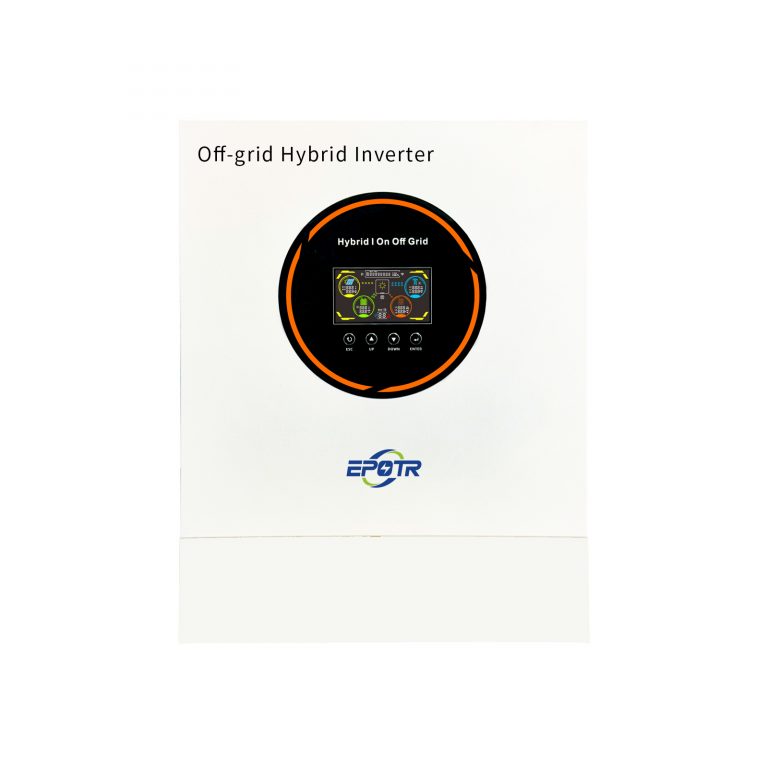
If solar and storage need coordinated conversion, compare the project requirements with EPOTR’s rentang inverter hibrida rather than assuming that one inverter works with every battery or grid connection.
A transparent ROI worksheet
Use a worksheet that separates measured benefits from assumptions. The core relationship is:
Annual net benefit = peak-cost savings + solar time-shift value + continuity value − energy losses − maintenance − degradation or augmentation cost
| Masukan | Apa yang perlu dikumpulkan | Why it matters |
| Load profile | Interval kW, operating hours, critical circuits | Determines power, energy and dispatch duration |
| Struktur tarif | Peak definition, energy price, demand or capacity charge | Sets the avoidable cost |
| Battery limits | Usable kWh, rated kW, reserve, efficiency and temperature limits | Prevents overstating deliverable energy |
| Project cost | Equipment, installation, protection, controls and commissioning | Defines the investment denominator |
| Operating horizon | Cycles, degradation, warranty, maintenance and replacement plan | Makes payback and sensitivity honest |
A simple payback calculation can be useful as a screening metric, but it should be shown beside a low, base and high case. If the investment only works under the highest tariff spread or the most optimistic cycling assumption, the project needs a different control strategy or a revised scope.
How the use case changes by facility
| Facility | Questions to answer before sizing | Likely operating priority |
| Hotel | When do HVAC and hot-water loads coincide with guest-service peaks? Which circuits are truly critical? | Peak shaving plus selective backup |
| Small or medium factory | Which shifts, motors or compressors set the maximum demand? Can production be scheduled around solar? | Peak control and production continuity |
| Supermarket | How much refrigeration load is continuous? What must run during an outage? | Refrigeration continuity and solar time shifting |
Implementation checklist for Vietnam
- Export interval load data and mark production, occupancy or trading hours.
- Confirm how the local tariff defines energy and demand charges for the site.
- Separate critical loads from convenience loads before choosing backup power.
- Model dispatch rules, reserve level, efficiency, degradation and maintenance.
- Review protection, fire-safety, ventilation, access and interconnection requirements.
- Commission the control strategy against the measured load curve, then compare actual operation with the model.
Pertanyaan yang sering diajukan
Does a larger battery always deliver a faster ROI?
No. A larger battery can add unused capacity if the site has a short peak or limited solar surplus. The useful size is the one that matches the measured power, duration and dispatch frequency.
Can one model be used for every hotel, factory or supermarket?
No. Grid connection, load shape, protection, critical-load priorities and local installation conditions must be checked for each project. Product capacity alone does not prove compatibility.
Where should a project start?
Start with interval data, the tariff document and a critical-load list. Then compare a measured base case with sensitivity scenarios before requesting a final system design.
How can I discuss a Vietnam C&I project with EPOTR?
Review EPOTR’s smart energy solutions and send the load profile, tariff structure, solar data and backup priorities through Hubungi EPOTR for a project-specific review.