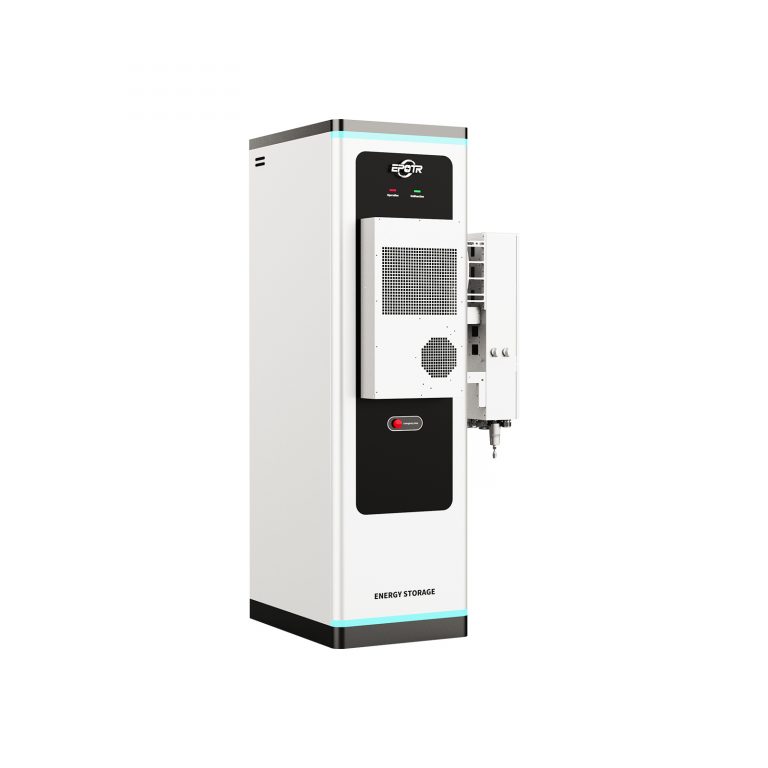

For a repeatable small or mid-sized commercial project, an all-in-one C&I energy storage system usually lowers delivery risk because more electrical, controls and thermal interfaces are resolved before the equipment reaches site. Separate PCS and battery cabinets can be the lower-risk choice when the project is genuinely bespoke—restricted layouts, staged multi-unit expansion, special redundancy, unusual grid requirements or a clear owner strategy for independent replacement.
The decision should therefore be made from the interface register, commissioning plan and responsibility matrix, not from cabinet count alone. “Integrated” does not eliminate project work, and “modular” does not automatically mean flexible.
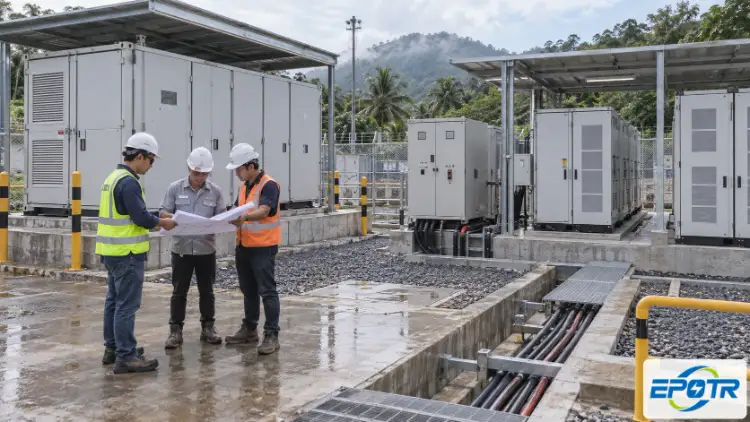
Compare risk across the whole delivery path
A purchase-price comparison captures only one moment in the project. Delivery risk accumulates through design freeze, approvals, factory testing, logistics, site installation, controls integration, acceptance testing and early operation. The architecture that is cheapest at the equipment line can still be expensive if it creates unowned interfaces.
| Project phase | All-in-one architecture | Separate PCS and battery cabinets |
|---|---|---|
| Design | Fewer internal interfaces; defined vendor envelope | More freedom, but more electrical, controls and thermal coordination |
| Procurement | Simpler package and responsibility boundary | Potential multi-vendor leverage; higher compatibility risk |
| Factory testing | Integrated functions can be tested as one package | Cross-vendor behavior may remain unproven until site |
| स्थापना | Less field interconnection for a standard unit | More cable, protection, networking and termination work |
| Commissioning | Shorter if the application fits the tested configuration | Can suit custom logic, but interfaces need explicit verification |
| विस्तार | Easy within published parallel limits | Potentially more flexible if the original design reserves every interface |
Where all-in-one equipment cuts delivery risk
Integration is valuable when it removes decisions from the site programme. A single package can arrive with battery modules, battery management, power conversion, thermal management and supervisory controls designed to work together. That can reduce field cable quantities, protocol mapping, cabinet-to-cabinet troubleshooting and disputes over which supplier owns a fault.
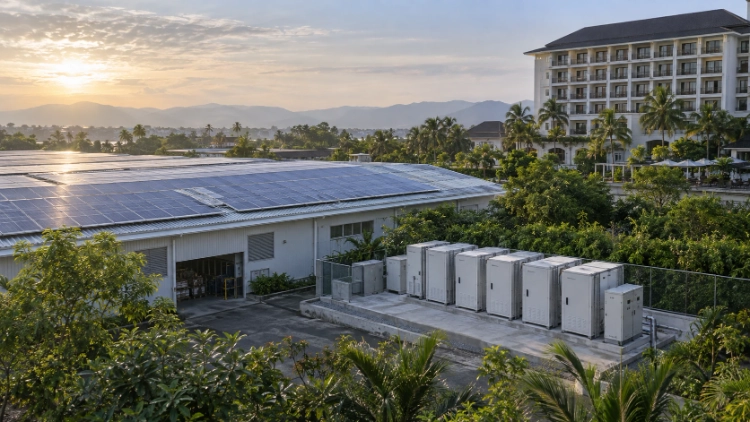
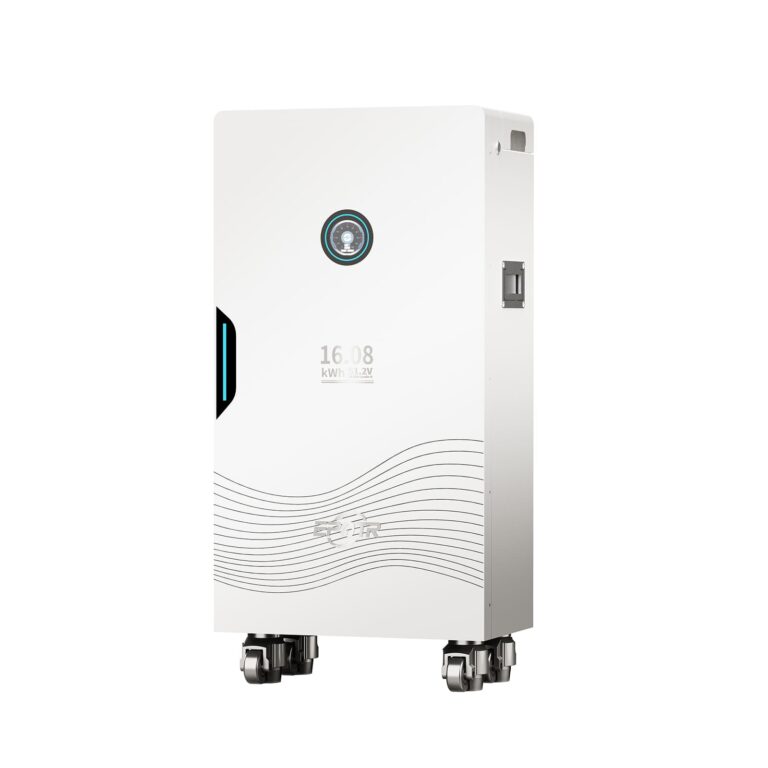
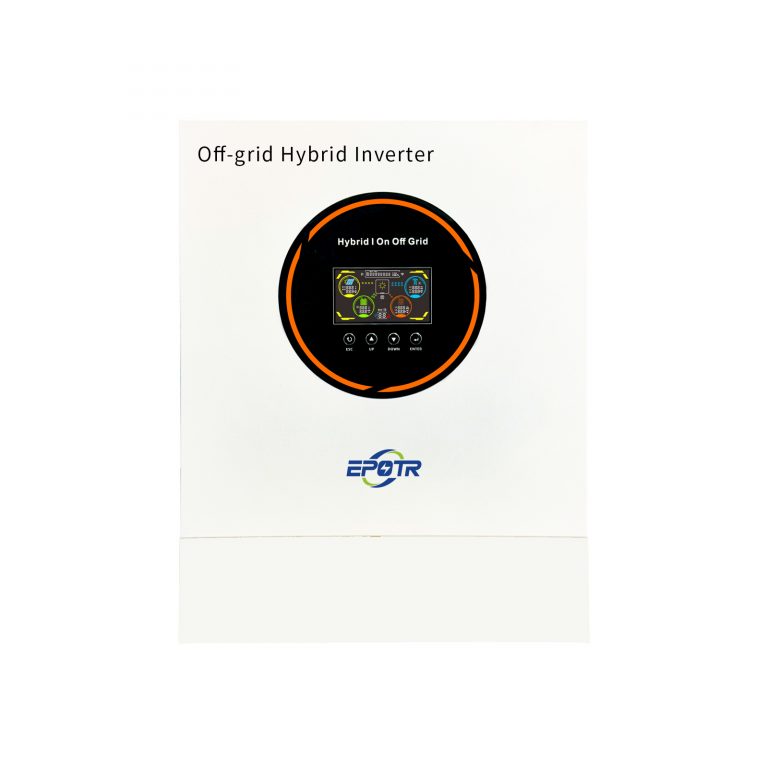
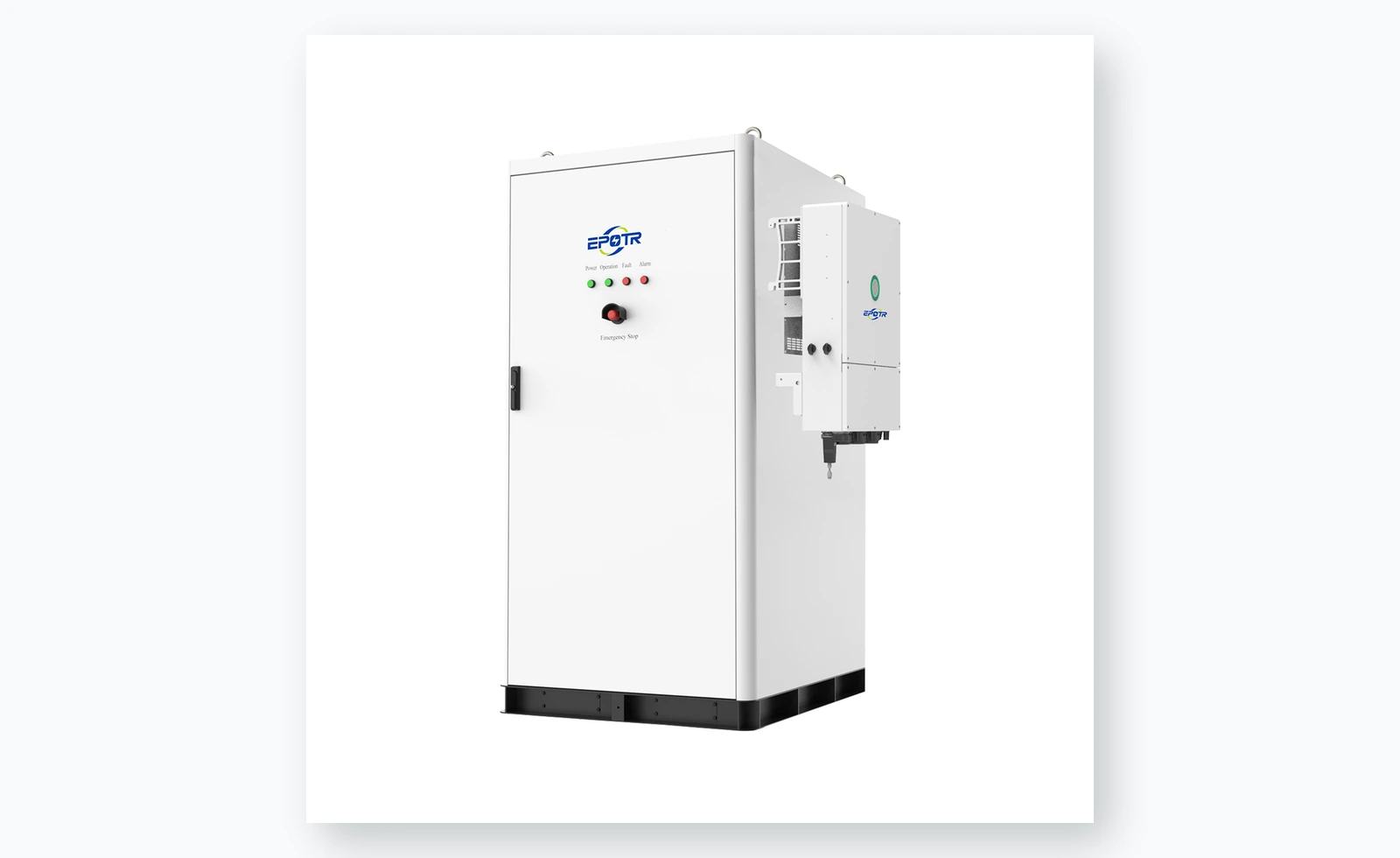
द EPOTR EP1 all-in-one hybrid C&I ESS is a useful example of the intended project shape. It combines LiFePO4 storage, a 50 kW conversion platform and controls, with 57.3–100.3 kWh rated-energy options. Its published envelope includes 55 kVA maximum apparent power, 75 kVA for five seconds, six MPPT inputs, AC and DC coupling, generator connection, grid/off-grid operation and parallel expansion.
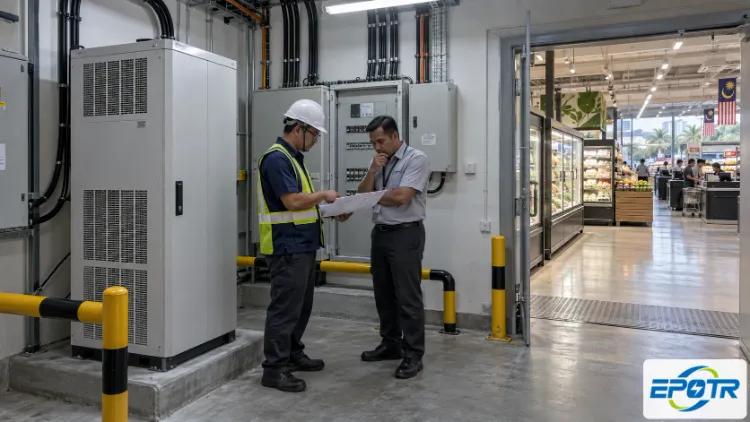
For a supermarket, farm or small factory with a conventional low-voltage connection and a clearly defined operating mode, those pre-engineered boundaries can shorten design review and commissioning. They also make it easier to place one party in charge of the internal equipment interfaces.
Integration still leaves external interfaces
The project team must still resolve the point of connection, upstream protection, earthing, anti-islanding, metering, export control, site communications, fire strategy, civil works and emergency response. If these external items remain vague, an all-in-one cabinet simply moves the uncertainty to its terminals.
When separate PCS and battery cabinets earn their complexity
A separate architecture is often justified by a constraint rather than a preference. The battery room may be remote from the transformer. A retrofit may have narrow access paths but several usable equipment zones. The owner may require N+1 conversion redundancy, independent replacement cycles, a particular grid-forming controller, or staged capacity additions that exceed the standard integrated envelope.
In those cases, separate equipment can reduce lifecycle lock-in and place power conversion where it best fits the electrical network. It can also support a deliberate multi-vendor strategy. But flexibility is real only when voltage windows, fault behavior, communications, control authority, warranties and future expansion are documented before orders are placed.
A broader C&I energy-storage portfolio helps compare integrated and cabinet-based configurations without forcing every project into the same mechanical format.
Count interfaces—not boxes
A practical architecture review can be run as a one-page interface register. Each row needs an owner, an input, an output, an acceptance test and a date. The most important interface groups are:
- Electrical: DC voltage range, AC voltage, short-circuit contribution, protection selectivity, isolation, earthing and auxiliary supplies.
- Controls: protocol, register map, time synchronization, setpoint authority, alarm ownership, export limits and black-start or grid-forming logic where required.
- Thermal and fire: heat rejection, airflow, detection, suppression, emergency stop, separation distances and first-responder access.
- Commercial: warranty boundaries, performance guarantees, spare parts, software support, remote access and responsibility for retesting after an update.
An integrated package typically reduces the number of internal rows. A separate design increases them, but may make external plant integration easier. Delivery risk falls when the remaining rows have named owners and testable acceptance criteria.
Compare total installed cost and schedule exposure
Do not compare only the PCS price plus battery price against the integrated cabinet price. Build both options to the same scope.
| Cost or schedule item | Question to include in the comparison |
|---|---|
| Engineering | Who produces protection studies, controls narratives, cable schedules and approval drawings? |
| Balance of plant | Are switchgear, transformers, DC protection, HVAC, fire systems, metering and communications included? |
| Testing | What is demonstrated at FAT, what remains for SAT, and who pays for repeat attendance? |
| Site work | How many lifts, foundations, terminations, cable routes and specialist teams are required? |
| Delay exposure | Which interface sits on the critical path, and what happens if one vendor is late? |
| Operation | Who supports firmware, remote monitoring, spares and fault diagnosis over the warranty period? |
A modest equipment saving can disappear after extra switchgear, engineering visits and cross-vendor commissioning. Conversely, paying for an integrated enclosure may add little value if the site already has suitable rooms, cooling, protection and a controls integrator. Use an installed-cost model and a realistic programme, then stress-test both against delay and rework.
Make standards and approvals part of the architecture decision
Southeast Asia is not one approval market. In Malaysia, the 2026 BESS safety guideline brings competent-person duties, registered electrical work, local-authority requirements, component evaluation, working clearances and factory/site acceptance testing into scope. In Singapore, the energy-storage standards and technical references include TR 77-1 for planning and performance assessment and TR 77-2 for safety considerations in grid-integrated electrical energy storage systems.
These examples should not be treated as interchangeable regional rules. The local designer and authority must confirm the current route for the exact country, grid connection, voltage level, location and use case. Architecture affects how easily evidence can be assembled: an integrated system may offer a clearer packaged test boundary, while a separate design may provide finer control over individually accepted components.
Use a simple decision rule
Choose all-in-one when repeatability matters most
Favor an all-in-one platform when power and energy fall within a standard envelope, site access accepts the cabinet, the operating mode is well understood, speed is important and one equipment party should own the internal interfaces. Review EPOTR’s commercial energy-storage solutions against the measured load profile and connection requirements.
Choose separate equipment when the constraint is genuinely project-specific
Favor separate PCS and battery cabinets when layout, voltage, redundancy, controls, staged expansion or replacement strategy cannot be met cleanly by the integrated envelope. Assign a named system integrator and require an interface matrix, compatible test configuration and complete FAT/SAT plan before releasing purchase orders.
अक्सर पूछे जाने वाले प्रश्नों
Is all-in-one always faster to commission?
It is often faster for a standard application, but only if upstream protection, metering, communications, export control and operating logic are ready. A late site interface can erase the factory-integration advantage.
Are separate cabinets always easier to expand?
No. Expansion requires reserved electrical capacity, compatible voltage windows, communications headroom, physical space and a controls strategy. “Modular” hardware without a documented expansion design can be difficult to extend.
Which option gives the better warranty?
The wording matters more than the number of suppliers. Check who owns system-level performance, exclusions at vendor boundaries, response times, software obligations and the test needed to prove a claim.
What should be decided before requesting quotations?
Fix the operating modes, power and energy duty, point of connection, site conditions, redundancy philosophy, expansion plan, required tests and responsibility matrix. Then discuss a project-specific architecture using the same input pack for every bidder.
The lowest-risk option is the one with fewer unowned decisions
For a standardized B2B project, an all-in-one energy storage system will often reduce engineering and commissioning exposure. For a constrained or highly customized project, separate PCS and battery cabinets can reduce long-term architectural risk. The reliable choice is the one whose interfaces, approval evidence, tests, warranties and future changes are explicit before the purchase order—not the one that merely shows fewer cabinets on a layout.